

From CIP to CDU: Applying Proven Cleaning Principles to Data Center Cooling Systems
As liquid cooling becomes the standard for supporting high-density AI and HPC workloads, data center operators are investing significant effort into cooling distribution units (CDUs) and their components; heat exchangers, pumps, piping systems, filters, and strainers. The focus is often on thermal performance, energy efficiency, and uptime. But there is another question that deserves equal attention:
How will the system be cleaned, flushed, and maintained?
At Sani-Matic, we’ve spent decades helping food, beverage, pharmaceutical, and personal care manufacturers solve complex process cleaning challenges. One lesson has remained consistent across industries:
Designing a system is only part of the challenge. Designing a system that can be effectively cleaned and maintained is what drives long-term reliability.
Today, we’re seeing the same opportunity emerge in liquid-cooled data centers.
A Familiar Pattern
In hygienic manufacturing environments, customers often spend months designing process skids, utility systems, and production lines. Cleaning considerations may not receive the same level of attention until startup approaches.
That’s when questions begin to surface:
- How will the system be cleaned?
- Can maintenance be performed efficiently?
- What happens when strainers or filters plug unexpectedly? How do I clean or replace them?
- Is there a way to verify that contaminants have been removed?
Addressing these questions after installation frequently leads to longer commissioning timelines, higher operating costs, and avoidable maintenance challenges.
As liquid cooling infrastructure expands throughout the data center industry, Sani-Matic is observing a similar pattern. Owners and engineers carefully specify CDUs, cooling loops, and filtration systems, but the practical realities of flushing, debris removal, and ongoing maintenance are sometimes treated as secondary considerations.
Startup Debris Is Real
Even new cooling systems can contain significant amounts of contamination. During fabrication, transportation, installation, and commissioning, debris can enter the system, including:
- Weld slag and weld beads
- Pipe scale
- Metal shavings
- Dust and dirt
- Gasket materials
- Thread sealants
- Packaging residue
Once coolant begins circulating, these contaminants travel through the cooling loop and are commonly captured by strainers and filters. Many operators are surprised by the volume of debris collected during initial startup.
The results can include:
- Rapid strainer loading
- Increased differential pressure
- Reduced flow rates
- Excessive strainer or filter changeouts
- Delayed commissioning activities
- Additional maintenance labor
In many cases, the issue is not that the filtration equipment is undersized. The issue is that the amount of debris generated during startup was underestimated.
Why Flushing Should Be Part of the Design
A successful flushing program does more than move water through a system. Its purpose is to remove contaminants before they can affect critical equipment such as:
- Cold plates
- Heat exchangers
- Pumps
- Control valves
- Quick disconnects
- Distribution manifolds
The principles are remarkably similar to those used in Clean-in-Place (CIP) systems throughout hygienic industries. Effective cleaning depends on understanding:
- Flow velocity (a minimum of 5.0 ft/s in applications is common for cleaning)
- Turbulence
- Debris transport
- Filtration efficiency
- Contaminant removal
- Verification methods
While the applications differ, the underlying objective remains the same – remove contaminants efficiently and keep them from returning to the process.
Strainers and Filters Are Only Part of the Solution
Strainers and filters play a critical role in protecting liquid cooling infrastructure. Selecting the proper mesh size, filtration level, and housing design is important, but it’s only one piece of the maintenance strategy.
Operators should also consider:
- How frequently elements may require cleaning
- Differential pressure monitoring methods
- Accessibility for maintenance personnel
- Spare element requirements
- Long-term service procedures
- System downtime during maintenance
As AI-driven data centers continue scaling to unprecedented cooling demands, maintainability is becoming just as important as performance.
The Often-Overlooked Question: How Will the Strainer Be Cleaned?
This question is common in industries where filtration systems operate continuously. Surprisingly, it’s becoming increasingly relevant in liquid cooling applications as well.
Data centers are finding that startup debris loads can be greater than anticipated, resulting in more frequent cleaning of strainer baskets and filter elements.
Without a defined cleaning strategy, maintenance teams may face:
- Increased labor requirements
- Inconsistent cleaning results
- Extended service intervals
- Unplanned downtime
Simply installing a strainer is not enough. A complete filtration strategy should consider the entire maintenance lifecycle, including how elements will be inspected, cleaned, verified, and returned to service.
Applying a Lifecycle Approach to Liquid Cooling
At Sani-Matic, we often encourage customers to think beyond equipment selection and consider the full lifecycle of operation and maintenance. For liquid-cooled data centers, that means asking critical questions during design and commissioning:
- Can the cooling loop be effectively flushed?
- Is filtration sized appropriately for startup conditions?
- How will strainers be cleaned and maintained?
- Do we need replacement strainer or filter elements?
- Is temporary flushing equipment required during commissioning?
- What procedures will support long-term coolant cleanliness?
- Can maintenance activities be performed quickly and safely?
Answering these questions early can help avoid costly operational challenges later.
From CIP to CDU
Since 1943, Sani-Matic has helped sanitary and hygienic manufacturers solve cleaning challenges where reliability, uptime, and process performance are critical.
The same engineering principles that support successful Clean-in-Place systems can be applied to modern liquid cooling infrastructure:
- Design for cleanability (to an extent appropriate for industrial applications)
- Remove contaminants efficiently
- Smart automation of CIP or flushing skids to verify and control the process
- Validate and track performance metrics
- Simplify maintenance
- Protect critical equipment

As liquid cooling continues to transform the data center industry, cleaning and maintainability deserve a place alongside thermal management and energy efficiency in the design conversation.
The ChillGuard® Approach
The ChillGuard® brand was specifically introduced to help data centers maintain clean, reliable cooling systems throughout commissioning and operation. Solutions may include:
- ChillGuard® Strainers
- ChillGuard® Custom Manifold supporting CDU construction
- ChillGuard® Filters
- Strainer cleaning equipment
- Commissioning and flushing skids (similar to automated CIP systems)
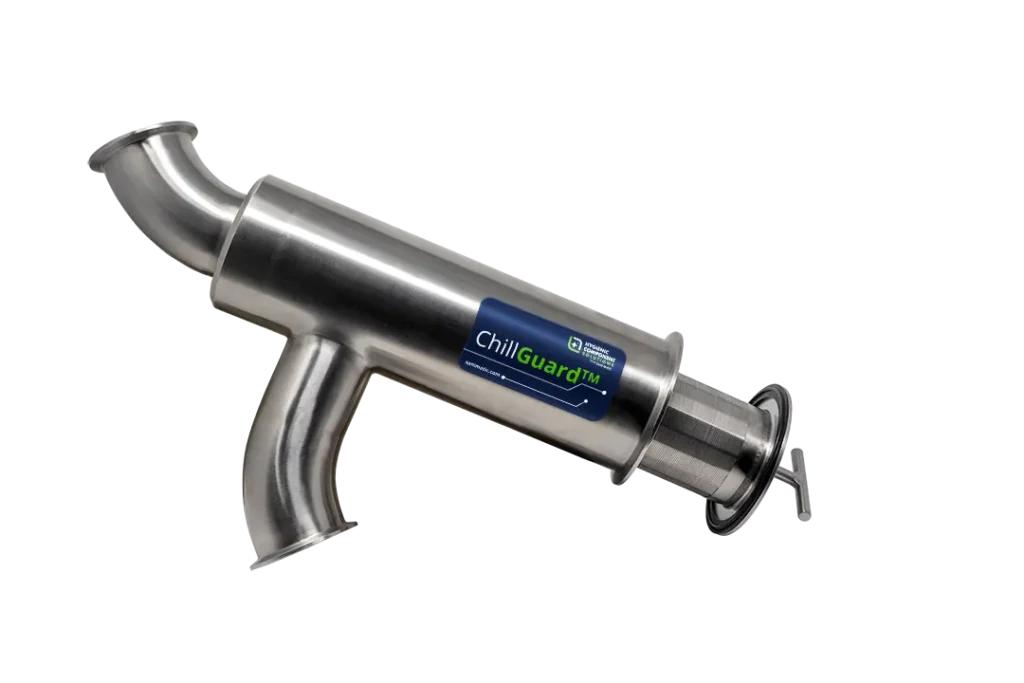

By combining proven filtration technologies with decades of cleaning expertise, Sani-Matic and its ChillGuard® solutions help data center engineers and operators answer not only “How will the system run?” but also “How will the system stay clean?”
Because when it comes to long-term reliability, cleaning isn’t an afterthought. It’s part of the design.