
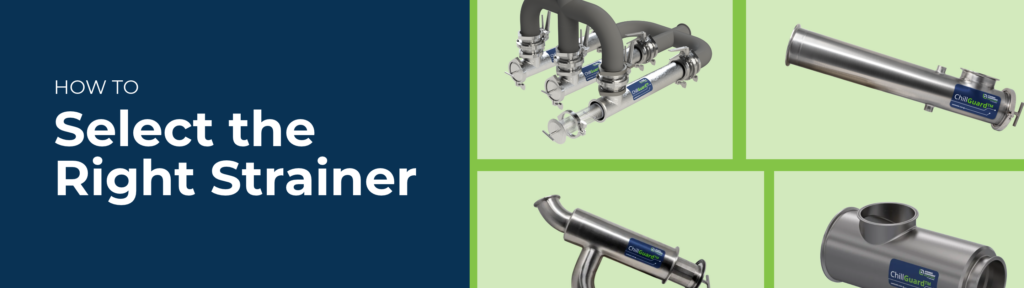
How to Select a Strainer for your Liquid Cooling Application
How to Select a Strainer for Your Liquid Cooling Application
The number of variables involved in strainer selection can make the process appear complicated. In practice, most applications can be evaluated by answering a handful of questions in a logical order. The decisions made early in the selection process often determine the range of acceptable solutions, making some considerations significantly more important than others.
QUESTION 1
What Equipment Is Being Protected?
The first and most important question in strainer selection is what equipment the strainer is intended to protect. Different components have different tolerances to foreign particulate, meaning a particle that passes harmlessly through one piece of equipment may damage, plug, or interfere with another. For this reason, the most sensitive downstream component often determines the level of protection required of the strainer.

A centrifugal transfer pump may tolerate particulate 1/16 inch (1.6 mm) in diameter or smaller with little impact on performance, while the same particle could plug a spray nozzle downstream of the strainer. In this case, the strainer should be selected to protect the spray nozzle. In doing so, the larger passageways of the upstream pump are also likely to receive adequate protection.
The most sensitive downstream component establishes the maximum particle size that should be allowed through an upstream stainer. The nature of the particulate should also be considered along with particle size. Fibrous material may rapidly blind a fine woven-mesh screen, while hard metallic debris may pass easily through a coarse perforated basket with larger openings if the downstream equipment can tolerate it. Understanding the behavior of the contaminant can further define the level of straining required and prevent unnecessarily fine selections that increase maintenance and pressure drop. However, particulate size should remain the primary consideration when establishing the required level of protection.
Further Questions to Consider
- Which downstream component is most sensitive to foreign particulate?
- What is the largest particle that component can safely tolerate?
- Does particulate primarily cause wear, plugging, fouling, or measurement inaccuracies?
- Is contamination primarily large debris, fine particulate, or a combination of both?
- Is the particulate soft, hard, fibrous, or abrasive?
- Is contamination continuous or occasional?
Successful strainer selection begins by understanding what particulate your most sensitive downstream equipment cannot tolerate. Strainers should be selected to remove that particulate while avoiding unnecessary pressure drop and maintenance requirements.
QUESTION 2
How Much Pressure Loss Can the System Tolerate?
While a strainer provides valuable protection against foreign particulates, the strainer cannot do this without creating a resistance to the process flow. This resistance, known as pressure loss, consumes energy within the system that equipment downstream of the strainer may require in order to function properly. Reduced spray performance, increased pump loading, and diminished heat transfer performance can all occur because of pressure loss across a strainer. While some pressure loss is unavoidable, excessive pressure loss can compromise overall system operation.
Pressure loss occurs because fluid must pass through the restrictive flow path created by the straining element. This path can become more restrictive, increasing pressure loss, in two ways: contaminant loading and increasing flow rate. As particulates accumulate within a strainer, available open area decreases, making it more difficult for fluid to pass through the element. Likewise, increasing the flow rate forces more fluid through the same available openings. In both cases, pressure loss increases. The selected strainer must be capable of maintaining acceptable pressure loss across the full range of expected flow rates and contaminant loading conditions. Strainer suppliers can often provide clean-element pressure loss curves to help estimate how differential pressure changes with flow rate before contaminant loading occurs.

One of the most effective ways to reduce pressure drop is increasing the available screening area. Larger straining elements provide more area for flow and typically experience lower differential pressure at a given flow rate. Additional screening area also increases contaminant-holding capacity, allowing the strainer to operate longer before particulate accumulation causes pressure drop to become unacceptable. Because of this, the largest practical strainer area should be selected. This approach minimizes pressure drop, maximizes contaminant-holding capacity, and extends service intervals.
Further Questions to Consider
- What pressure loss can occur before process performance is affected?
- Does the process have sufficient available pressure to accommodate the strainer?
- How much additional pressure drop can be tolerated before cleaning is required?
- Will system flow rates vary significantly during operation?
To avoid differential pressure that negatively impacts system performance, a strainer should be sized for the full range of expected operating conditions. Larger strainers typically provide lower pressure drop and greater contaminant-holding capacity, allowing longer operating periods before maintenance becomes necessary.
QUESTION 3
Where Should the Strainer Be Installed?
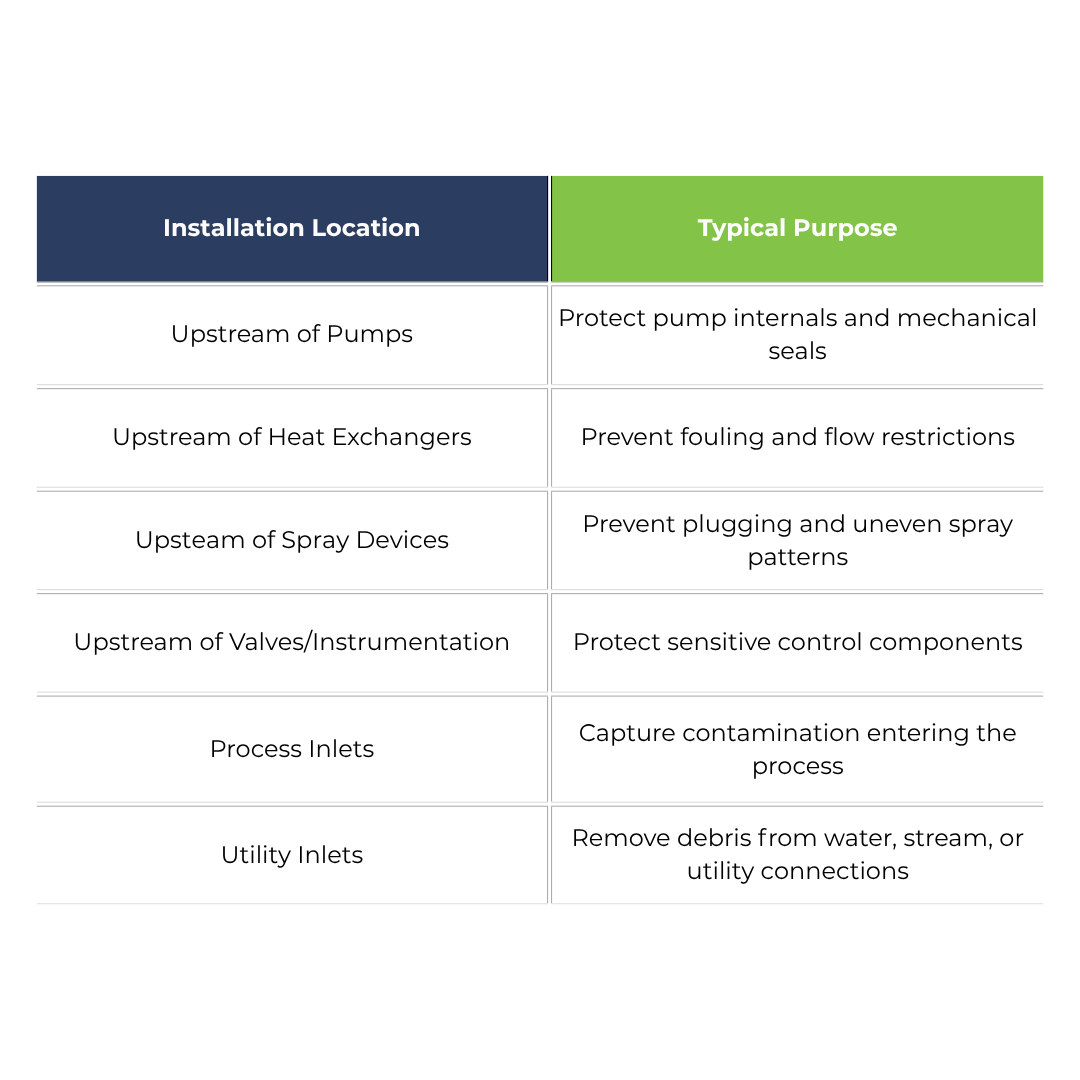
Once the required particulate retention and acceptable differential pressure have been established, the next step is determining where the strainer should be installed within the process. A properly selected strainer can only protect the process if it is installed where contaminants can be intercepted before reaching the equipment or operation of concern. While several installation locations may be technically acceptable, some locations provide greater protection, lower maintenance burden, or broader process benefits than others.
In most applications, the preferred location for a strainer is immediately upstream of the equipment or process requiring protection. This minimizes the amount of piping between the strainer and the protected component, reducing the opportunity for particulate to enter the system after straining has occurred. Locating the strainer close to the protection point also makes it easier to ensure that the intended equipment receives the full benefit of the selected retention rating.
The primary exceptions are serviceability and broader contamination-control objectives. A strainer that is difficult to inspect, clean, or service may create operational challenges that outweigh the benefits of the ideal protection location. And as maintenance frequency increases, accessibility becomes increasingly important. Understanding the anticipated cleaning interval maintenance procedure helps establish the appropriate balance between accessibility and proximity to the protected equipment.
When contamination is expected to enter from a known source, such as a process inlet, utility connection, or bulk ingredient transfer point, locating a strainer near the point of entry may provide broader system protection. However, an inlet strainer in one location may not protect against contaminants introduced elsewhere in the process. In many applications, particularly sensitive equipment such as spray devices, instrumentation, control valves, or heat exchangers may still warrant dedicated strainers installed immediately upstream of the component being protected.
Further Questions to Consider
- What equipment is ultimately being protected?
- Where is contamination most likely to enter the system?
- Can the strainer be accessed safely for inspection and cleaning?
- Would multiple strainers provide more effective protection than a single installation?
Strainers should generally be installed as close as practical to the equipment or process they are intended to protect. The ideal installation location intercepts contaminants before they create problems while still allowing safe and convenient maintenance.
QUESTION 4
How Will the Strainer Be Maintained?
Eventually, every strainer will require maintenance in the form of cleaning. As particulate accumulates within the straining element, differential pressure increases and system performance begins to decline. The primary objective of strainer cleaning is to restore the element as closely as possible to its original clean condition, thereby returning differential pressure (pressure loss) to an acceptable operating level.
While the objective of cleaning remains the same, the methods used to achieve it may vary significantly between facilities. Common approaches include Clean-Out-of-Place (COP) washing, the application of pressurized water, solvent cleaning where appropriate, or facility-specific cleaning procedures. Regardless of the selected method, cleaning should remove retained particulate without damaging the straining element or introducing new contaminants into the process.
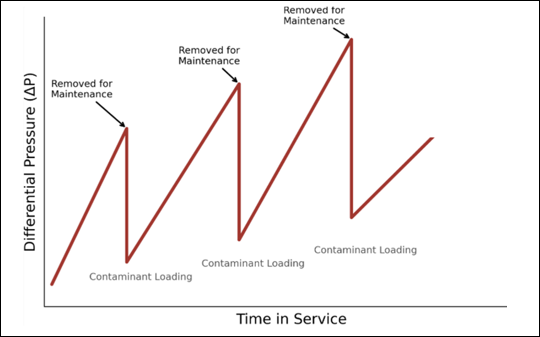
Beyond restoring differential pressure, maintenance should be performed with minimal labor, downtime, and disruption to production. A cleaning process that completely restores strainer performance may require excessive labor, prolonged downtime, or specialized resources that are difficult to justify for routine maintenance. In many applications, a cleaning procedure that safely restores most of the available open area and returns the strainer to service quickly may provide the best overall result. The most effective maintenance strategy balances cleaning effectiveness with operational efficiency while maintaining an acceptable level of system performance.
Further Questions to Consider
- How will the strainer element be cleaned?
- Can the strainer be serviced safely and conveniently?
- How much differential pressure recovery is expected after cleaning?
- Would a larger strainer reduce cleaning frequency?
- Would a duplex or self-cleaning design reduce operational impact?
The goal of strainer maintenance is not simply to remove visible debris, but to restore differential pressure as closely as possible to the original clean condition. The most effective maintenance programs maximize pressure-drop recovery while minimizing downtime, labor, and the risk of recontamination.
Successful strainer selection rarely depends on a single factor. The ideal particle retention may create excessive pressure drop. The largest practical strainer may not fit within the available footprint. The most thorough cleaning procedure may not be the most practical maintenance strategy. Nearly every application requires balancing competing priorities.
Fortunately, the selection process can usually be simplified by working through the same questions covered in this document. First, identify the equipment being protected, then determine what particulate must be removed, how much pressure loss can be tolerated, how much contamination must be held, where the strainer should be installed, and how it should be maintained. The answers to these questions often narrow the range of acceptable solutions considerably.
In the end, successful strainer selection is less about finding the "best" strainer and more about finding the right compromise for the application. A well-selected strainer provides reliable equipment protection, manageable maintenance requirements, acceptable pressure drop, and long-term operational value without introducing unnecessary complexity into the process.
Need help answering these questions based on your process or looking to get going on your strainer setup? Contact us here or click here to learn more about our ChillGuard Strainers.
About Sani-Matic Inc.
Sani-Matic delivers reliable hygienic process solutions through expert engineering, automation, manufacturing, and service. Founded in 1943 and based in Wisconsin, the company serves industrial, food service, food and beverage, consumer goods, and pharmaceutical markets. Its portfolio includes CIP and COP cleaning systems, hygienic components such as strainers, spray devices, and tank components, ChillGuard® liquid cooling protection solutions, Data and Analytics software, and food service washers from Douglas Machines, a Sani-Matic company. Supported by its ShieldCare℠ customer success and service teams, Sani-Matic transforms every equipment purchase into a long-term partnership.